
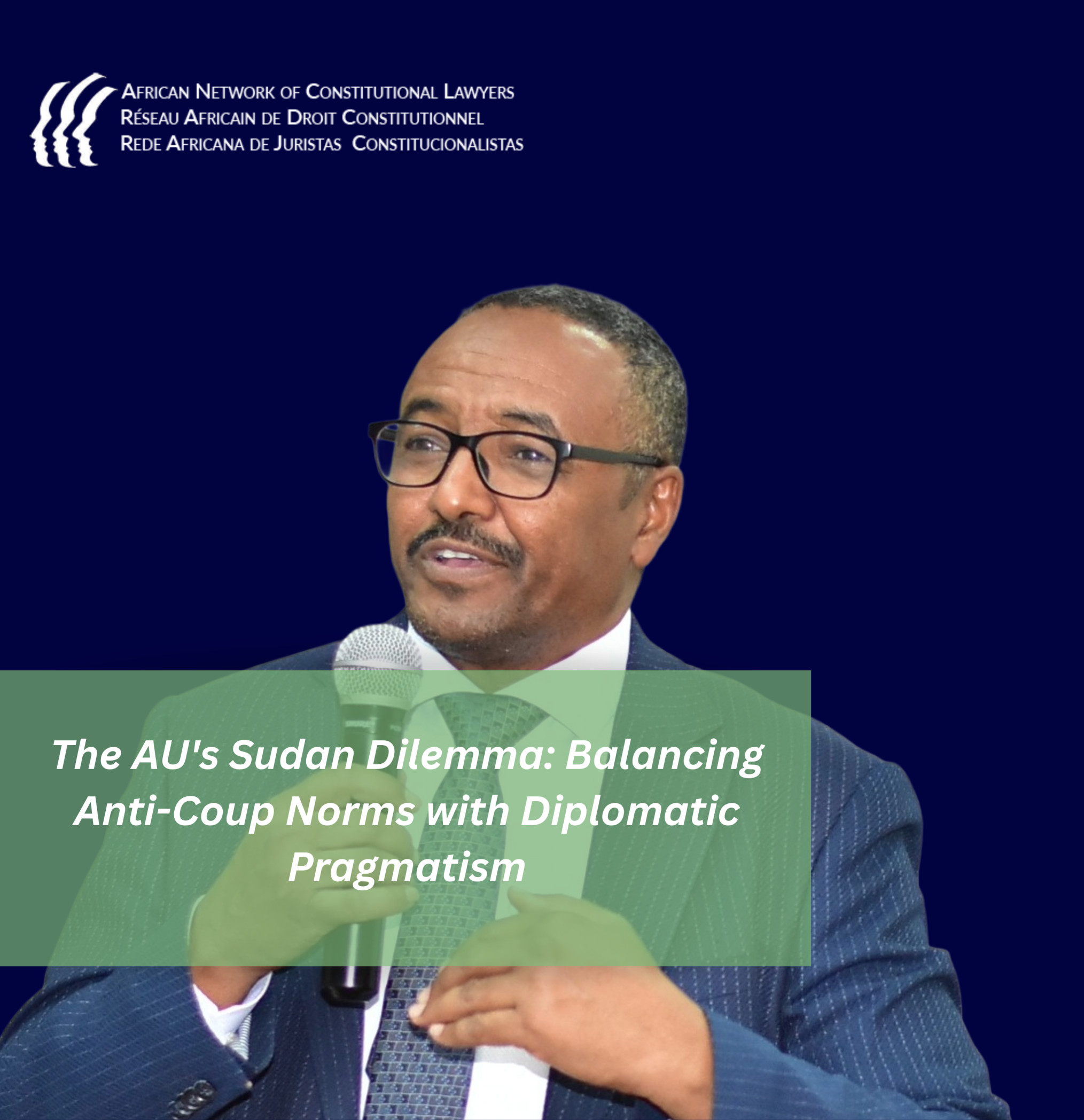
By Dr. Sami Abdelhalim Saeed
Since the military coup d’etat in Sudan, on 25 October 2021 and the subsequent outbreak of war in April 2023, the African Union (AU) has faced a profound dilemma in Sudan in term of balancing its "zero tolerance" policy for Unconstitutional Changes of Government (UCG) with the pragmatic need to discuss an existential crisis in Sudan, an AU founding member. While Sudan’s membership in AU remains officially suspended to uphold constitutional governance, the AU is increasingly applying a normalization approach of the political landscape by the "step-by-step" strategy. Recently, Egypt championed this approach during its February 2026 Chairmanship of the Peace and Security Council (PSC). The goal was to restore Sudan’s AU membership by using informal consultations with the PSC and re-engagement in the AU technical committees. This allowed Egypt to maintain diplomatic influence without formally legitimizing the military regime in Sudan.
Conversely, Sudan’s military generals still actively seek readmission, providing the AU with a diplomatic "carrot" for ceasefire negotiations. The PSC in its meeting on February 12, 2026, affirmed the suspension of Sudan’s membership. The PSC argued that Sudan Arm Force (SAF) still holds ultimate power, and constitutional order has not yet been fully achieved. By maintaining Sudan’s suspension in early 2026, the AU signaled its commitment to promoting constitutionalism and strengthening its anti-coup norms.
AU Legal Framework for Promoting Constitutionalism
The AU has moved from a policy of non-interference, typical of its predecessor the Organization of African Unity (OAU), to non-indifference. This shift is evident in the AU policy on eliminating unconstitutional changes of power and has produced a robust, though sometimes unevenly enforced, legal framework to prevent and punish unconstitutional changes of government in the continent.
The AU has designed a coherent and integrated legal framework, wherein each component complements the others and the entire system is interpreted collectively to articulate the strong protection of constitutional governments in the continent from military coup d’état and the pursuit of power through force. The AU framework for addressing UCG is anchored in the AU Constitutive Act of 2000, which establishes a policy of zero tolerance for the unconstitutional seizure of power. The Lomé Declaration of 2000 identifies four specific triggers, including military coups and mercenary interventions, while the African Charter on Democracy, Elections and Governance (ACDEG), adopted in 2007 broadens the definition to encompass so-called "constitutional coups," such as unlawful extensions of presidential terms. Enforcement responsibilities are assigned to the PSC, in accordance with the PSC Protocol (2002) which implements suspensions and oversees the restoration of democratic governance within specified timelines.
The Legal Basis for Sudan’s Suspension from the African Union
On October 25, 2021, the military unconstitutionally suspended the provisions of the Constitutional Declaration 2019. It dissolved the transition cabinet and arrested the Prime Minister together with most of the ministers. There was no legal basis for the suspension of the Constitutional Declaration. This is because such suspension would have required the approval of both the Sovereign Council and the Transitional Cabinet.
This arguably constitutes the offence of rebellion against the constitutional regime under Article 164(1) of the Armed Forces Act of 2007. It makes provision for punishment by;
“death, or imprisonment, for a term, not exceeding twenty years together with the possibility of deprival of all, or part of the pension, or privileges for whoever does, agrees or plans with others to affect the constitutional, or security regime, or unity of the country, by use of military force, or wages war against it, or does the material, or ethical preparation therefor, or commits any acts, or does any communications, or equipages, as by nature cause the same.”
As such, the 2021 coup d’état was manifestly illegal under Sudan’s constitutional, military and criminal laws.
Based on the above, on October 26, 2021, the AU issued a communique on the situation in Sudan. Emphasizing article 4(p) of its Constitutive Act (which establishes the principle of condemnation and rejection of unconstitutional changes of governments), article 7 (g) of its Protocol Relating to the Establishment of the Peace and Security Council and the ACDEG, it decided, to suspend, with immediate effect, the participation of the Republic of Sudan in all AU activities until the effective restoration of the civilian-led transitional authority.
The AU Mediation Gap: Balancing Peace and Constitutionalism in Sudan
Suspending member states from the AU creates a complex paradox for the PSC. While intended to isolate military juntas, suspension often triggers a "mediation gap" that diminishes the AU’s leverage, pushing regimes toward non-democratic partners while stripping the AU of its "left-hand" diplomatic intimacy. This structural estrangement complicates essential negotiations, as seen in the ongoing Sudanese conflict, where the inability to formally engage warring parties hampers peace-building efforts. Furthermore, suspension risks regional fragmentation. These initiatives also inadvertently punish the populace, as international development aid often dries up alongside diplomatic status, fueling nationalist narratives that paint the AU as an elitist, hostile outsider. To navigate these pitfalls, the AU’s PSC is increasingly shifting toward hybrid approaches or a shifting, dual-track strategy, such as informal consultations. This pragmatic evolution allows the AU to maintain the technical oversight necessary to steer transitions and oversee peace processes without granting the legitimacy that comes with full membership, effectively balancing principled pressure with the necessity of continued engagement.
The Sudan crisis (2021–2026) exemplifies the AU's struggle to balance legal integrity with diplomatic pragmatism. Despite intense lobbying for readmission to facilitate mediation between warring factions, the PSC maintained Sudan's suspension in February 2026 to uphold anti-coup norms. To navigate this deadlock, the AU adopted a "step-by-step" normalization strategy. By engaging through technical committees, coordinating via the "Quintet" group ( AU, IGAD, UN, The League of Arab States (LES) and The European Union (EU), and reopening a liaison office in Port Sudan, the AU provides essential humanitarian and peacebuilding support on the ground without formally legitimizing the military regime or compromising its foundational AU’s constitutive principles.
At first glance, it seems that the AU policy of combating unconstitutional change of governments conflicts with the mandate of the AU-PSC’s mandate to maintain peace and security in the continent. It may appear to political analysts that the AU-PSC failed to see the trajectory of the peace process in Sudan after the suspension of Sudan’s membership due to the military coup of October 2021. Obviously, the AU aims to balance these by insisting that peace and security cannot be restored without a return to a consensus on civilian-led transitional government. The 2025 AU priorities focus on restoring constitutional order and protecting civilians as foundational to stability. In addition, the AU's strategy involves the implementation of the revised policy of Post-Conflict Reconstruction and Development (PCRD), aimed at both repairing state-society relations and democratic governance.
The AU’s PSC has the experience of restoring constitutional order in Africa, but continues to face significant challenges in the Sahel, Madagascar, and Sudan. The AU recently lifted the suspensions of Guinea on January 22, 2026, and Gabon in April 2025, following successful presidential elections in both countries. This process—transition, new constitution, elections, and reinstatement—now serves as the model the AU urges the remaining nations to adopt.
Sudan plays a multifaceted role in continental peace and security that extends beyond the armed conflict between the Sudan Arm Force (SAF) and the Rapid Support Forces (RSF). The AU’s Peace and Security Council is encouraged to engage with Sudan on these broader challenges. However, Sudan’s ongoing suspension is likely to constrain the Council’s effectiveness. Furthermore, Sudan faces unresolved disputes with Ethiopia regarding the Al-Fashaga Region in eastern Sudan, as well as ongoing issues related to the contested Abyei Region with South Sudan.
Dr. Solomon Ayele Dersso recommended that, when addressing the challenges of "Peace" and "Democracy" within the context of ACDEG, the AU should adopt an inclusive transitional framework, instead of privileging a single perspective. Dersso’s approach advocates for a negotiated agreement in which the military commits to a specific timeline for withdrawal from politics, while the rebellion consents to disarmament. This strategy enables simultaneous progress toward both peace and democracy.
The AU's ability to initiate a peace process for Sudan depends on successfully balancing anti-coup legal framework with a pragmatic, dual-track diplomatic strategy. By applying an inclusive process approach that synchronizes military withdrawal with civilian-led government, the AU can bridge the "mediation gap" and maintain peace and democracy in Sudan.
Dr. Sami Abdelhalim Saeed is a Sudanese constitutional expert and legal scholar with over 15 years of experience advising United Nations missions on peacebuilding and legal reforms in post-conflict environments.