
By Achileus Tardzenyuy
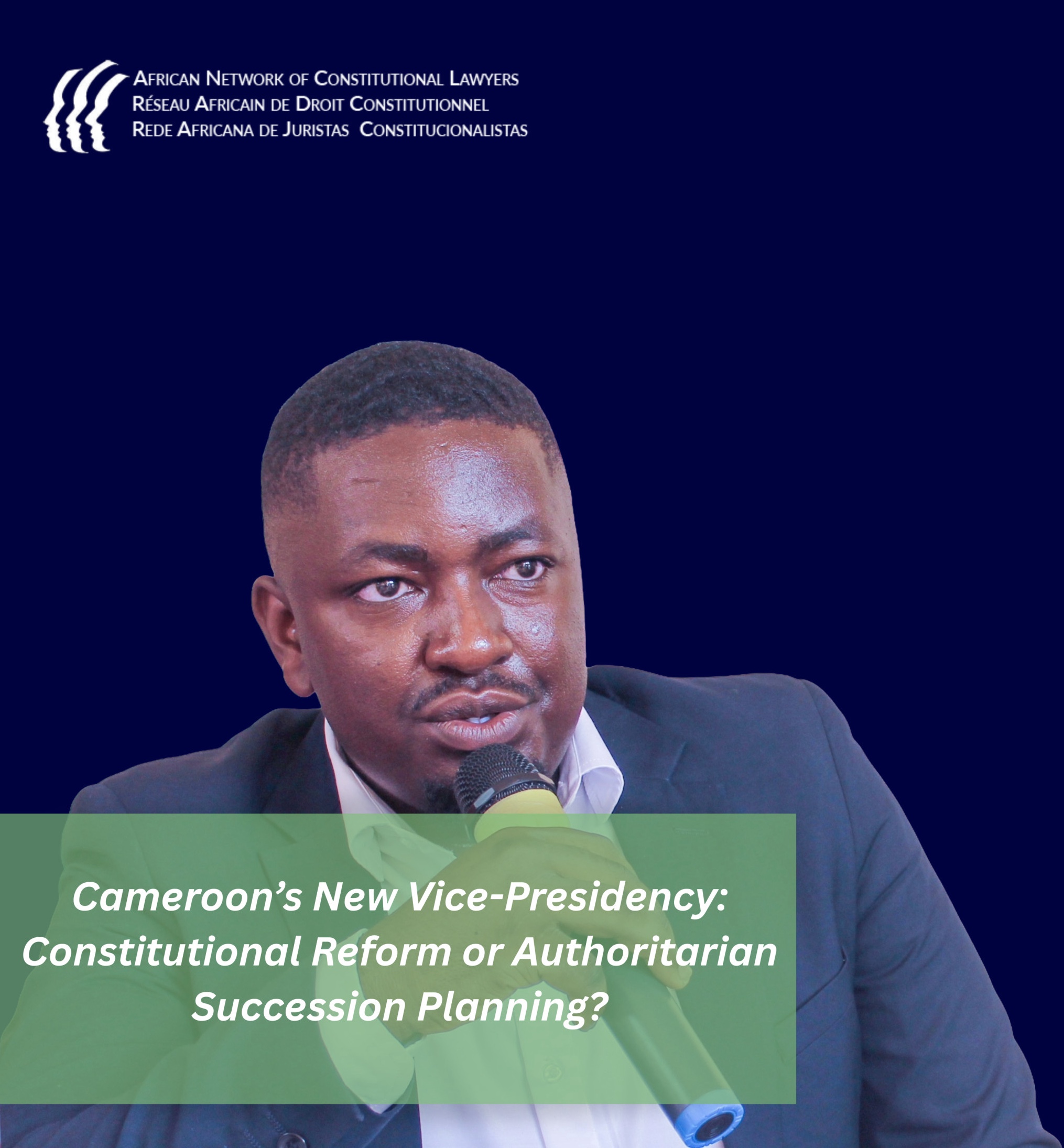 Cameroon’s Parliament has adopted one of the most consequential constitutional changes in recent years: the reintroduction of the office of Vice-President. A total of 200 lawmakers voted in favour of the bill, while 16 voted against and 4 abstained. On its face, the reform appears to respond to a legitimate institutional concern how to ensure continuity in the event of presidential vacancy. However, the way the office has been designed raises profound constitutional, democratic, and political concerns.
The reform does not create a Vice-President elected by the people. Instead, it creates a Vice-President appointed and dismissed by the President of the Republic. Yet that same appointed Vice-President automatically becomes the constitutional successor in the event of the President’s death, resignation, or permanent incapacity.
This is not merely a technical amendment. It is a fundamental restructuring of presidential succession in Cameroon.
Under the previous constitutional framework, if the Presidency became vacant, the President of the Senate assumed interim office and a new presidential election had to be organised within 20 to 120 days. That process, however imperfect, at least preserved a minimal avenue for political competition and democratic choice.
The New Reform Replaces Uncertainty with Control.
The constitutional amendment modifies Articles 5, 6, 7, 10, 53 and 66 of the Constitution. It allows the President to appoint the Vice-President, determine his or her functions, and dismiss him or her at will. More importantly, in the event of a vacancy, the Vice-President completes the remainder of the presidential term and may even appoint another Vice-President to assist in office. This effectively transfers the power to determine succession from the electorate to the incumbent President.
The danger is not the existence of a Vice-President itself. Many constitutional democracies have Vice-Presidents. The problem lies in the mode of designation and the concentration of power it creates.
The Cameroon Bar Association captured this concern in its observations on the draft bill. It argued that allowing an appointed Vice-President to complete the term of an elected President “undermines the principle of the election of the President of the Republic by universal suffrage” and erodes the democratic legitimacy of the office. The Bar further questioned the usefulness of the office given that the President may continue to bypass the Vice-President by delegating powers directly to the Prime Minister or other members of Government. In that sense, the reform creates a powerful successor without creating a genuinely independent constitutional office.
This is why Professor Maurice Kamto has described the reform as a “constitutional coup”. He has also initiated a petition titled: NO TO THE CONSTITUTIONAL AND INSTITUTIONAL COUP IN CAMEROON PERPETRATED BY THE CPDM REGIME. More than 60000 thousand Cameroonians have already signed the petition Newspaper headlines in the days following the vote spoke of a “firestorm over constitutional reform”, “condemnation galore”, and a nation “stunned” by what one publication called a political “masterclass”. These reactions may be dramatic, but they reflect a deeper public anxiety: the growing sense that constitutional law is increasingly being used to consolidate power rather than constrain it.
Breaking with Cameroon’s Tradition of Democratic and Regional Balance
Perhaps the most striking criticism came not from the opposition, but from within the ruling CPDM itself. Senator René Ze Nguele, one of the oldest and most respected figures in the Senate, openly rejected the bill. He argued that democracy depends on the people choosing their leaders and warned that once leaders begin to appropriate that role for themselves, democracy ceases to exist.
His intervention was important not only because it broke party discipline, but because it recalled an earlier constitutional tradition. Under the federal arrangements that existed before 1972, the President and Vice-President were elected, and there was an expectation of linguistic and regional balance between the two offices. The current reform abandons that logic entirely.
That is particularly significant in a country marked by deep Anglophone-Francophone tensions. The new law does not require that the Vice-President should come from a different linguistic community than the President. If the President is Francophone, the Vice-President may also be Francophone. As several commentators have observed, these risks reinforcing long-standing perceptions of exclusion among Anglophone communities and deepening already fragile national cohesion.
The reform is also troubling because it comes within a broader pattern of constitutional and institutional changes that appear aimed at preserving regime continuity. Parliament has already voted a bill which extended its own mandate repeatedly till December 20th 2026, the president of the Republic has also extended Mandates of municipal councillors. New bills are now being introduced to amend the laws governing the Constitutional Council and the Electoral Code to align them with the new succession framework. The amendment of article 170 of the Electoral code will allow the Head of State to extend the mandates of Municipal Councillors without limitation.
Step by step, Cameroon is constructing a new architecture of power.
Its defenders argue that the reform provides stability, avoids costly presidential elections in moments of crisis, and guarantees continuity of the State. There is some force in these arguments. Cameroon is not immune from uncertainty or institutional paralysis. Yet stability cannot come at the expense of democratic legitimacy.
A constitutional system cannot remain democratic if the most important political office in the country may ultimately be inherited through appointment rather than election. This is what makes the new Vice-Presidency so consequential. It is not merely about creating another office in the executive branch. It is about changing the rules of political inheritance.
The central question in Cameroon is no longer simply who will govern after President Paul Biya. It is whether Cameroonians themselves will have the opportunity to choose that person. If the answer increasingly lies in presidential appointment rather than popular vote, then Cameroon risks moving away from constitutional democracy toward a form of authoritarian legalism where power is entrenched not through open repression alone, but through carefully designed legal reforms that preserve the appearance of constitutional order while hollowing out its democratic substance.
Achileus Tardzenyuy is a Doctoral Research Fellow at the University of Buea, Cameroon and a Human Rights Officer, Africa Albinism Network.
Cite as: A.Tardzenyuy, (2026) Cameroon’s New Vice-Presidency: Constitutional Reform or Authoritarian Succession Planning? Available at: https://ancl-radc.org.za/blog/cameroons-new-vice-presidency-constitutional-reform-or-authoritarian-succession-planning (Accessed: [date] [month] [year])